Corpo Pagina
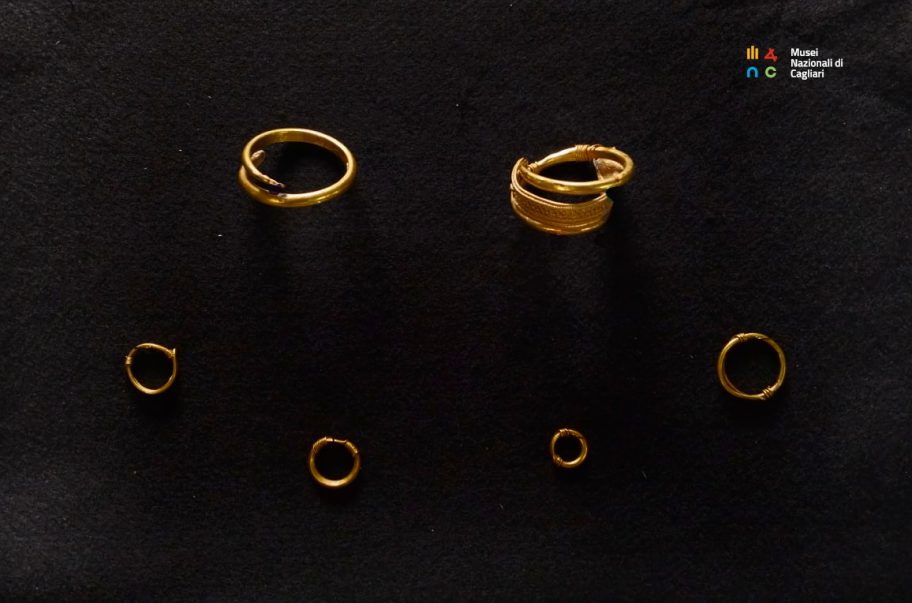
In the Phoenician-Punic world the production of small goldsmith’s objects played a primary role, with artefacts intended for both female and male personal adornment. Among the most widely documented types are the so-called braid rings, also known as hair rings, which are attested in both funerary and domestic contexts.
Five examples of different sizes are displayed here, some from Tharros and others from undocumented locations. Their chronological framework can be placed between the 6th and 4th centuries BC.
These objects consist of a circular rod wound into a spiral of approximately one and a half turns. The ends, gradually tapering, are bent so as to form a kind of spring mechanism that allowed the ring to be opened and closed around the braid, thereby securing it in place.
Hair rings were generally made entirely of gold or composed of a bronze core covered with a thin gold sheet.
Among the objects exhibited is one example featuring a swan-head terminal, a motif paralleled in the wider Punic Mediterranean. Also noteworthy is a hair ring made using the techniques of filigree and granulation; two very similar examples come from Carthage and are now preserved at the Bardo National Museum, in Tunis.
Filigree is a goldsmithing technique that consists of creating decorative motifs through the intertwining and twisting of extremely fine gold or silver wires, which are then applied and soldered onto a metal support. Granulation, by contrast, involves soldering tiny spheres, known as granules, onto a metal surface — generally a sheet — according to a predetermined design. Both techniques require a high degree of technical skill and show the hight level of craftsmanship achieved by Phoenician-Punic artisans.
The primary function of braid rings was ornamental: they were used to secure the hair in the desired hairstyle, contributing to the aesthetic prestige of the wearer. At the same time, the preciousness of the materials and the quality of workmanship made them indicators of social status, likely associated with families of considerable economic means.
