Corpo Pagina
The first human settlements in Villaputzu area date back to prehistoric times. Numerous Bronze Age sites exist, such as the domus de janas of Torre Murtas and S’Oru and the underground burial site of Casa ‘e Forrus.
The most significant traces, however, are those of the Nuragic civilization. There are numerous nuraghes, both complex and single-tower. We highlight Sa Pudda nuraghe, a complex structure built on a ridge north of the town. The structure consists of a keep with a tholos chamber and a bastion that encloses it with a sinuous curtain wall connecting two lateral towers. The building, preceded by a rampart, is characterized by the use of large, unworked schist blocks.
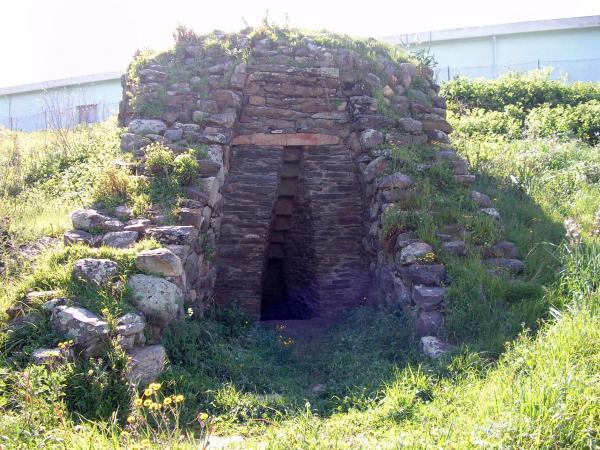
The beautiful Nuragic sacred well of Is Pirois, with a circular cross-section, has steps to reach the water and is covered by a tholos roof. It features a rectangular vestibule constructed with two rectilinear walls, likely originally covered by a gabled roof.
In the locality of Santa Maria, 3 km from the mouth of Flumendosa River, lies the port of a town identified by scholars as the ancient settlement of Sarcapos, known from the Itinerarium Antonini, a geographical work from the Roman Imperial period that lists the main communication routes. The site, likely inhabited as early as the Bronze Age, grew in importance after the settlement of a Phoenician community starting in the 7th century BC, maintaining a central role throughout the Punic era, and then the Roman and early medieval periods.
The presence of argentiferous lead deposits inland was certainly a great advantage for Sarcapos, which was constantly present on Tyrrhenian trade routes between the 7th and 3rd centuries, as evidenced by the large number of transport amphorae and ceramics discovered.
To date, 174 excavated burials have been identified and investigated near the riverbank. This was the necropolis of Sarcapos, dating between the 4th century BC and the 1st century AD. The pit burials, 60 to 70 cm deep, show overlapping phases of use, so that the Punic-era burials (all inhumations) were overlaid by those of the Roman period.
The chamber tomb of Su Presoni, a hypogeal burial with arcosolia excavated in the limestone rock face at the base of the Quirra Castle relief, dates back to the Roman Empire.
The masonry mausoleum of Cirredis also dates back to the Roman period, and contains the remains of sarcophagi and various grave goods (coins, jewelry, ceramics). This structure was later reused in the Byzantine era.
Immagine in evidenza: Sacred well of Is Pirois
ph. Aschy, CC BY-SA 3.0 <https://creativecommons.org/licenses/by-sa/3.0>, via Wikimedia Commons
