Corpo Pagina
Villasalto area, a village of Gerrei region, shows traces of human habitation since the Bronze Age. The Nuraghe Corrulia, a single-tower structure constructed from polygonal blocks of limestone schist, dates back to this period. It features a small access corridor with two opposing sort of sentry boxes.
Serra Madau site consists of a single-tower nuraghe on the rock overlooking the valley of Rio S’Acqua Callenti, a tributary of Flumendosa, and of a megalithic structure of uncertain plan. Both structures exploit the morphology of the rock outcrops, to which they adapt.
At over 700 meters above the sea level, on Mount Genis, stands Sa Domu ‘e sa nì complex, a Nuragic settlement with a central structure, possibly a nuraghe.
The settlement of Cea Romana, consisting of a village and a funerary area, dates back to the Roman period. The settlement consisted of numerous quadrangular and circular structures built with calcareous schist stones. The necropolis, located on a steep slope, extended approximately 200 meters from the settlement. Some burials were cremated, with or without an urn, and some were inhumated. In cremation burials, the urn was placed directly above the bustum. In burials without an urn, the bones were placed at the bottom of the pit, mixed with the layer of charcoal from the combustion. Inhumation burials consisted of lithic caissons made of limestone or schist slabs placed sideways. Various grave goods from the necropolis, dating between the 1st and 5th centuries AD, are on display at the National Museums of Cagliari.
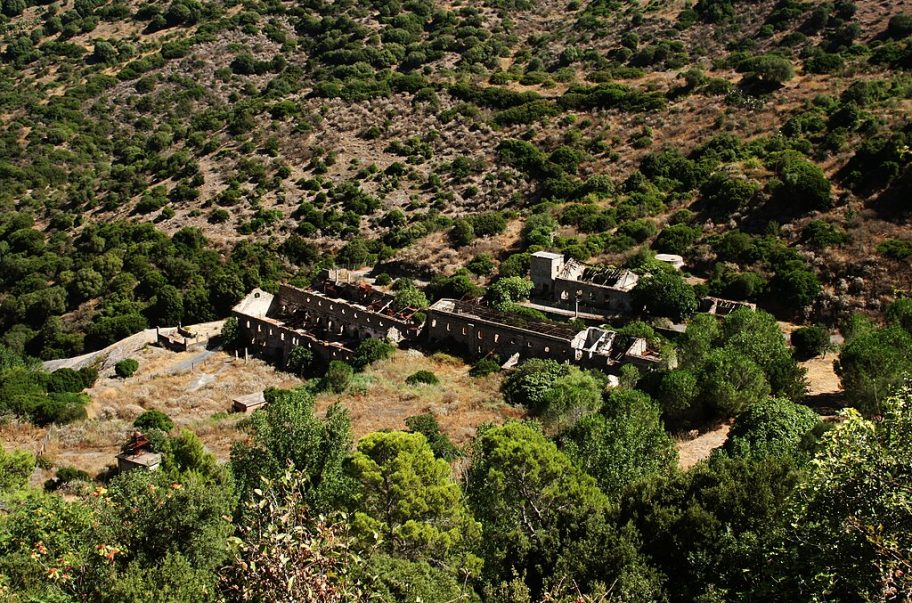
Featured picture: Miniera di Su Suergiu
Stefania.misale, CC BY-SA 4.0 httpscreativecommons.orglicensesby-sa4.0, via Wikimedia Commons
