Corpo Pagina
The territory of Selargius, a municipality part of the Metropolitan City of Cagliari, was heavily populated since prehistoric times. Evidence of this is the Eneolithic village of Su Coddu (fourth-third millennium BC), one of the most important Prenuragic settlements for size and importance of the findings. Located on the Northern outskirt of the modern town of Selargius, it was made up of about 150 huts, with wells, silos to store food and hearths. Its surface was around 10 hectares, and stretched almost to the pond of Molentargius. The roof of the huts, some of which have a more complex plan, was made with a wooden frame and branches, covered with pressed clay. The roof was supported by poles fixed on the ground by holes which were found.
The pieces of clay found in the area of the village show the prints of poles and shrubs. Among the finds there are some tripods pots, bowls, dishes, “olle”, assegai obsidian arrowheads, two figurines of female divinity in marble of the cruciform type and some brass artifacts. The site was inhabited since the middle of the fourth millennium BC, between 3200 and 2600 BC, and is ascribable to the cultures of Ozieri and sub-Ozieri.
The necropolis connected to the village has not yet been investigated.
Other prenuragic villages are the ones of Staineddu and Cuccuru Matt’e Masonis.
The sacred well of Santa Rosa, not far from the village, connected to the ancient cult of water, dates back to the Nuragic era. Its structure is typical of the hypogean temple, very common in Sardinia. These places, as well as being the source of water supply for the community, were also an important place of worship.
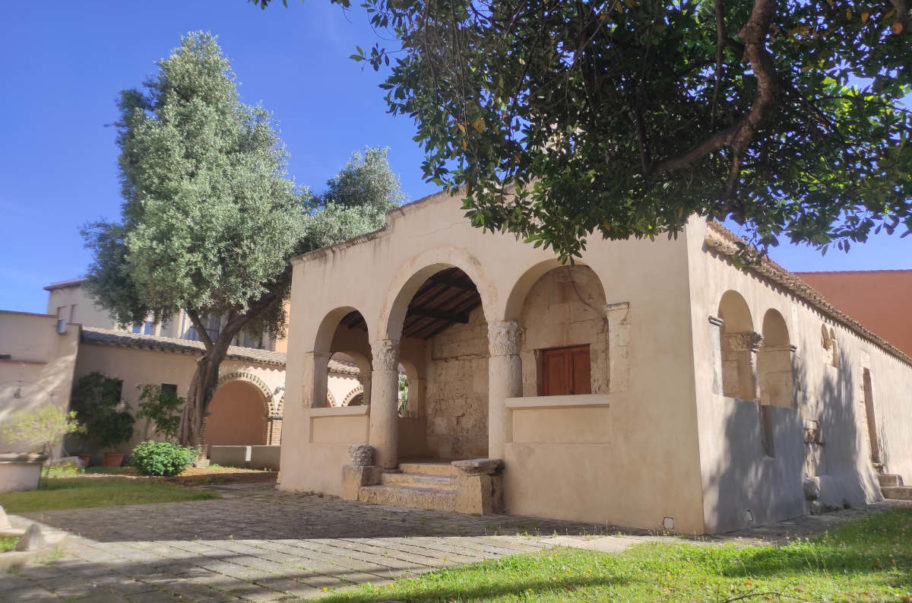
Dates back to the Roman period the sarcophagus displayed at the church of Saint Lussorio. This is a beautiful example of Romanesque architecture. Of the same period are also some columns and capitals of the church of Saint Giuliano which came from a Roman building.
Picture: Romanesque Church of Saint Giuliano (12th century)
