Corpo Pagina
The area of Guspini, a town in Monreale region located between Oristano area and Iglesiente hills, rich in metal deposits, shows traces of human settlement dating back to the Neolithic.
Evidence have been found in the domus de janas, such as that of Bruncu Maddeus, and in the menhirs of Perdas Longas and Prunas. Su Corrazzu de is Pillonis enclosure, a megalithic wall attributable to Monte Claro culture, dates back to the Copper Age.
During the Nuragic period, the area was widely inhabited, as evidenced by the numerous nuraghes, sacred springs, and giants’ tombs. Among the nuraghe, we have to mention Melas or Fumiu, a polylobed structure, preserved in excellent condition, located on the north of Guspini, along the road that links Neapolis, the ancient city that guarded the landing place in the lagoon, and Metalla, the center that controlled the rich metal deposits of Montevecchio.
Noteworthy is Mudegu nuraghe, also called Arrosu or Cuasa Pia, a trilobed structure located on the south of Guspini, on the mountainside, protecting the fertile Campidano plain and the metal deposits.
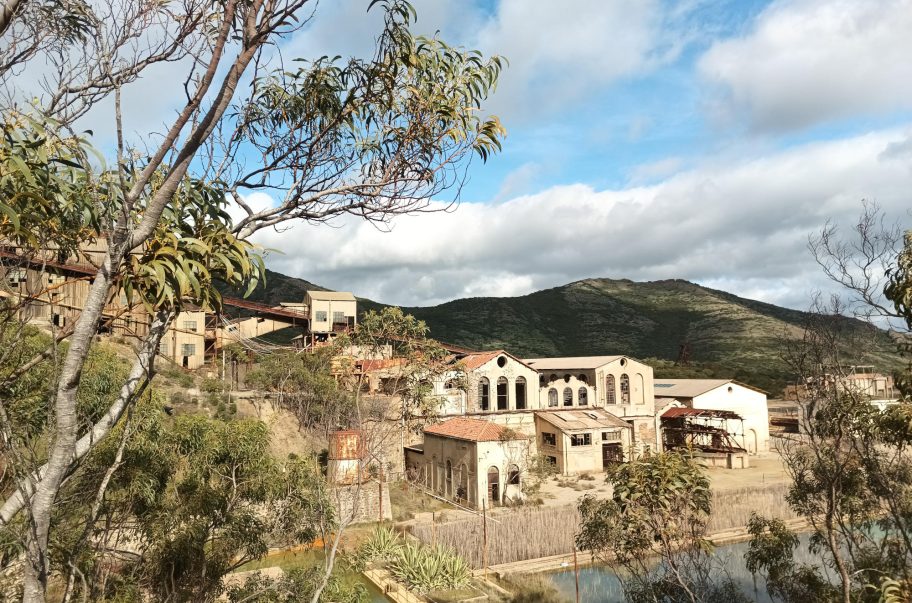
A series of Roman-era bronze buckets, discovered by chance and purchased by the Royal Archaeological Museum of Cagliari in 1937, comes from Montevecchio Mine. The buckets, tied to the chain of a vertical wheel, were used to lift water that flooded the mine shafts.
The main site in the area is certainly the city of Neapolis, located on the banks of Santa Maria pond. The settlement was founded by the Phoenicians between the second half of the 8th and the first half of the 7th century BC and underwent significant expansion during the Punic period, between the 5th and 4th centuries BC. Very little is currently known about the city layout during this period. It is known that the city was surrounded by walls, while the suburban area contained a necropolis and a possible artisanal sector connected to a smelting plant.
Outside the city walls, there should have been a sanctuary dedicated to a healing deity, to whom anatomical votive offerings were made, especially human figurines of the sick, now on display at the National Museums of Cagliari. The statuettes of suffering devotees touch with their hands the parts of the body affected by the disease for which the deity had been prayed for.
Even in Roman times, it was a thriving center, with important public buildings, baths, and roads, of which a section of the decumanus, paved with basalt and sandstone paving stones, still survives. The two bath buildings, dating to the late 2nd-early 3rd century AD, are Grandi Terme (Great Baths) and Piccole Terme (Small Baths). The section of the road at Tibula Sulcis leading to the city and the castellum aquae, originally connected to the aqueduct, are still present.
For the early medieval period, archaeological data speak of a contraction of the settlement and a transformation of the Great Baths into a Christian place of worship with the name of Santa Naria di Nabui.
Featured image: Montevecchio mine
