Corpo Pagina
Gonnesa area, in the heart of Sulcis-Iglesiente, is rich in archaeological finds, thanks to its rich subsoil. The massive presence of metallic minerals, such as lead, zinc, and silver, has made this area a magnet since ancient times.
The area shows traces of settlements dating back to the Neolithic, as evidenced by the domus de janas tombs carved into the rock banks: for example, the twenty burials of Serra Maverru necropolis and the Murru Moi domus de janas, consisting of a short pavilion, an antechamber, and a burial chamber, unfortunately ruined by its use as an animal shelter.
The megalithic circles of Punta Seruci and Muromoi, likely of funerary function, also date back to Ozieri Neolithic.
The two Monte Claro culture villages of Is Bangius and Generè date back to the Copper Age. The first is composed of more than 20 rectangular or trapezoidal structures, sometimes with an apse. In the second, the huts are built with slabs and blocks arranged in a diagonal pattern.
The vases exhibited at the National Museums of Cagliari date back to the same period. They were discovered by chance in 1992 on the outskirts of the hamlet of Nuraxi Figus and were part of several burials. Due to the circumstances of their discovery and the limited size of the investigated area, it is difficult to identify the tomb type. On the other hand, the presence of a significant quantity of stones near the finds could suggest the existence of stone-lined graves.
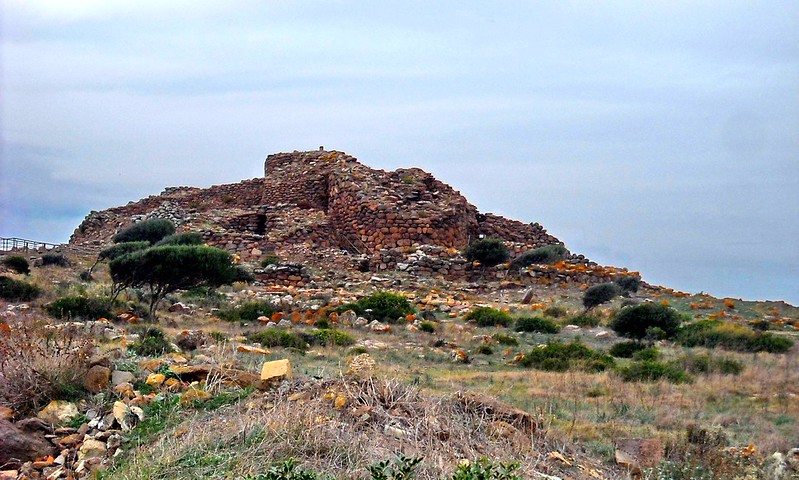
Human presence during the Nuragic period was significant, as evidenced by the large number of nuraghes and settlements. Some of these are particularly complex, such as the site of Serbegi, consisting of a complex building, a village of huts, also served by a natural basin, and at least one giant’s tomb. However, the most significant site in the entire Sulcis region is the nuragic complex of Seruci, consisting of an imposing complex nuraghe, a turreted outer wall, a village of over 100 huts, and two giant’s tombs, one of which is no longer located. The nuraghe, built from blocks of local andesite, consists of a keep surrounded by four or five towers joined by a bastion. The village is made up of simple circular huts and isolated huts. The site is strategically located at the foot of Iglesiente mineral basin, above a valley rich in pastures and crops, controlling the pass that leads from Iglesiente mountains to the sea and to Sulcis region.
From the Imperial Roman era, remain Culmine necropolis, with pit tombs excavated at the base of Monte Gennerei relief, and a wine tank carved into the tuff rock near Nuraxi Figus. The structure, likely connected to a no longer existing residential building, consists of a large rectangular pressing tank with decanting cups, linked to a smaller tank via a channel with a spout.
Featured picture: Nuraghe Seruci
ph. Cristiano Cani CC BY-NC-SA 2.0 (flickr.com)
