Corpo Pagina

In 238 BC, shortly after the end of the First Punic War, Sardinia was occupied by Rome and later became part, together with Corsica, of the provincia secunda.
The first two centuries passed in substantial continuity as can be seen from the new excavations, which identified many levels belonging to this period both in sacred and residential areas.
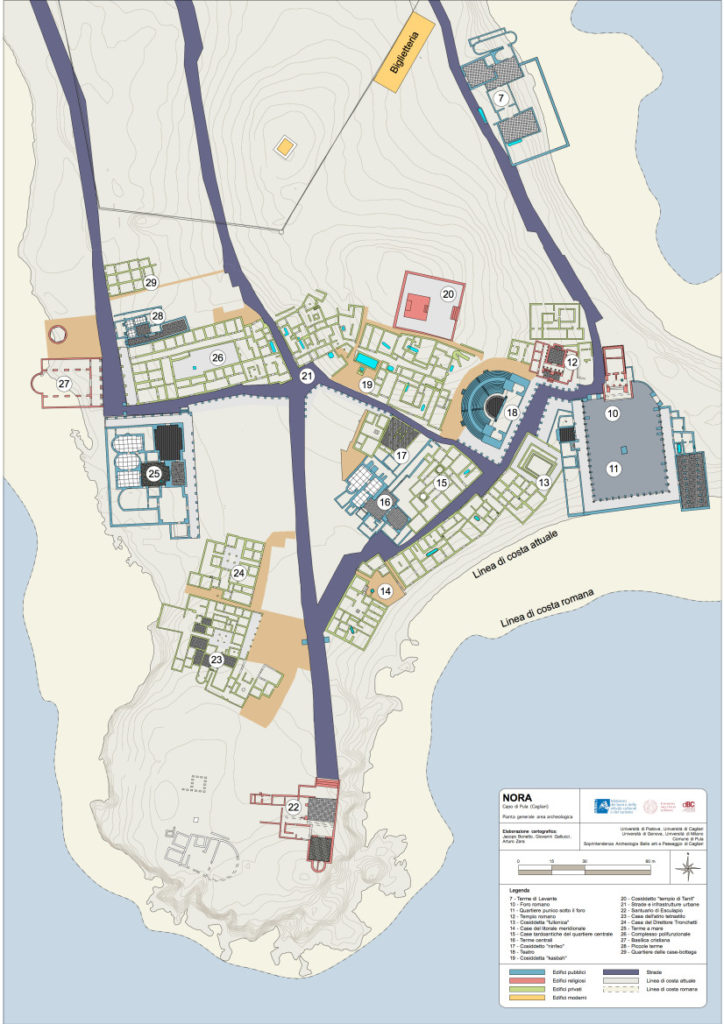
Big urban changes occurred starting from the Augustan Age. The grafting of new, large public areas reveals a change not only in the appearance but also in the life of the city itself, which conformed with the transformations happening in the rest of the Roman world.
At first the Forum, a large square that included the place of worship at the end of the main axis, was opened, but a large area used for houses and warehouses, left partly visible by recent excavations, was demolished and flattened.
In the first half of the first century AD another typical building of a Roman city, a theatre which could accommodate up to 1000 spectators, was built not far from the Forum. It partly exploited the slopes of the central hill, on top of which stood one of the preceding Phoenician-Punic sacred areas. The stately homes located there were razed to the ground. This theatre, which still preserves the terraces of the lower part of the cavea, is of purely Roman type, with a high-rise stage in large blocks which reached the height of the cavea, joined at it. Today only the foundations remain, because the large blocks of the elevation were removed between 1500 and 1600 to be used in new buildings, as happened also to other large block walls visible at that time in the ruins of the city, as in the temple on the Forum and in the central thermal baths.
These two creations, Forum and theatre, introduced the richest and monumental phase of the city, the one that is even now the most visible.
The road that ran across the city, from the port to the Forum, was largely flanked by arcades and shops, as in some Medieval cities. Several traces of them are today still visible on the whole route.
The houses generally gravitated on an internal open area, often equipped with a well or a cistern for rainwater. They were frequently decorated with earthenware or opus signinum floors and frescoed walls. Sizeable parts of these paintings have been found almost everywhere: near the port road, in the houses beyond the Forum and towards the tower, in those of the central district and of the south-western marina, where there are the most extensive examples. In the same area there are the remains of a central impluvium on four columns, raised again at the middle of the last century, belonging to the house called “ of the tetrastyle atrium”.
In this context, around the middle of the second century AD the construction of the aqueduct brought substantial changes. Remains of the arches can still be seen along the isthmus and from the road that leads to modern Pula. In the city it can be followed only thanks to the presence of reservoirs and fountains along the roads (clearly visible at the current entrance, near the eastern bay and, on the other coast, on the road to the port). The water supply and disposal changed, the sewage system was renewed and, at least partly, the street paving was built.
Furthermore, the new water availability made possible the construction of large thermal buildings, built in areas which until that time had been occupied by the residential area. Today the remains of four thermal buildings are visibile; in the two major and better legible ones, called the Central Thermal Baths and the Great Baths at Sea, the usual articulation in access environments, cold environments and heated environments with floors on suspensurae, among which flowed the hot air coming from the ovens, two tepidaria that served as a link and the warmer part and the calidarium are recognisable.
At that time, the port experienced a new remarkable development, enough to require the construction of a large horreum or public warehouse, erected where the harbour road entered the city. Individual warehouses are placed here around a large, central and uncovered space, while shops open onto the streets that surround the complex.
In this period, Nora also went through the great season of mosaics, which found themselves in private houses all around the central area, as in the so-called tetrastyle atrium house, but also in public spaces, like thermal baths, open porticoes on the Forum and temples.
Testo di Jacopo Bonetto / Text by Jacopo Bonetto
Traduzione di Gabriele Demurtas / Translation by Gabriele Demurtas